 Scentmark
Short answer: The easiest wins are letting your dog sniff more, changing the route, and walking with a friend. Small games, a little training on the go and a new place every few weeks do the rest.
Let the nose lead
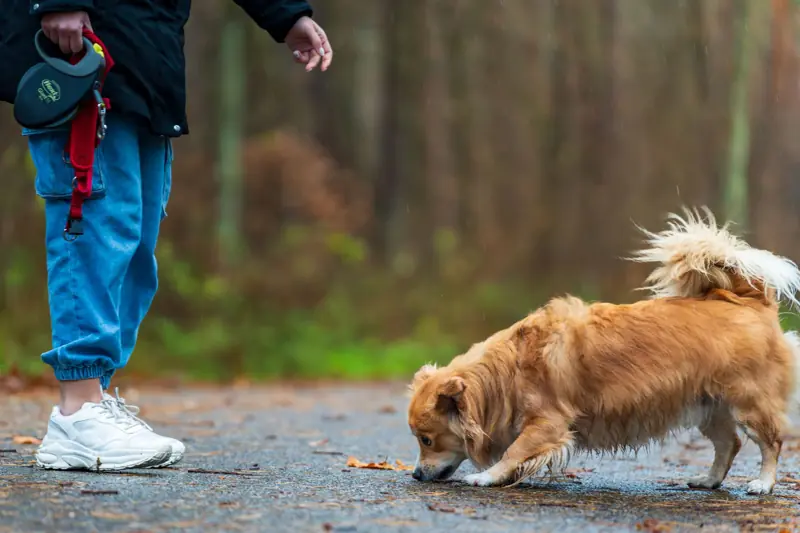
- Take a sniff walk. Once a week, let your dog choose the pace and direction, and stop as long as they like. Sniffing is how dogs read the news. In one study, dogs that did two weeks of regular scent work became measurably more “optimistic” in a behavior test.1
- Use a longer leash somewhere quiet. A 10 to 15 foot line in a park gives room to explore while staying in control, and it’s how trainers recommend practicing recall before letting a dog off leash.2 Clip it to a harness, and keep the regular leash for sidewalks.
- Scatter a few treats in the grass and let them search. Two minutes of “find it” is a big deal to a dog.
Change the map
- Walk your usual loop backwards. Everything smells different from the other direction.
- Turn down one street you’ve never walked. Every walk, pick one new block. In a month your neighborhood gets bigger.
- Make a loop instead of an out-and-back. Loops show you more ground for the same time. In Scentmark, closing one also claims everything inside it.
- Drive somewhere new on the weekend: a trail, a beach that allows dogs, a different neighborhood’s park.
- Try a different time of day. The early-morning street and the after-dinner street are different worlds.
Bring company
- Find a walking buddy. A neighbor with a dog your dog likes makes the walk social for everyone. Parallel walking is a gentle way for new dogs to meet: start about 10 feet apart in neutral territory, walk side by side with loose leashes, and move closer only if both dogs stay relaxed.3,4
- Join a pack walk or start one. A regular Saturday loop with three or four dogs becomes the best part of the week.
- Bring the kids and give them a job: carrying the bags, spotting other dogs, choosing left or right at each corner.
Small games
- Practice one cue per walk. A sit at every curb, a “look” when a bike passes, a recall on a long line in the park. Short and rewarding. If your dog pulls, stop the moment the leash goes tight and only move on once it’s slack again; dogs pull because it has worked for them before.5
- Use the furniture of the street. A low wall to hop up on, a bench to walk around, a tree to circle. Agility without the equipment, as long as it’s safe and allowed.
- Take a photo each walk. The stick of the day, the first snow, the puddle they would not skip. A year of them is a lovely thing to look back on.
- Keep score. Total miles this month, new streets walked, turf held. A little tracking turns the daily walk into a story.
Keep it safe
Check the pavement on hot days (how hot is too hot), wipe paws after salty winter sidewalks (how cold is too cold), bring water on long walks, follow local leash rules, and don’t push an older or short-nosed dog to keep up. Older dogs do best with shorter routes and more rest stops.6 If you’re not sure how much walking your dog needs, read how long to walk a dog.
Sources
- Duranton C, Horowitz A. “Let me sniff! Nosework induces positive judgment bias in pet dogs.” Applied Animal Behaviour Science, 2019. doi:10.1016/j.applanim.2018.12.009
- Dogs Trust. “Recall training.” dogstrust.org.uk
- Seattle Humane. “Introducing your new dog to your resident dog.” seattlehumane.org
- RSPCA South Australia. “The dog adoption handbook: making introductions.” rspcasa.org.au
- Dogs Trust. “How to stop your dog pulling on the lead.” dogstrust.org.uk
- PDSA. “Exercising your senior dog.” pdsa.org.uk
Read next: Scentmark, the dog walking app that turns walks into turf